 por PedroCunha » Qui Nov 15, 2012 08:36
Olá. Achei esta questão na internet
(ITA – SP) – A equação

tem:
a. Três raízes reais;
b. Uma raiz dupla igual a 1;
c. Não tem raízes complexas;
d. S = {1; i ; - i};
e. Nda.
e não estou conseguindo fazer ela.
Tentei usar produtos notáveis para reduzir a equação, mas cheguei em uma equação de segundo grau, o que está errado, pois a resposta certa é a letra
D Alguém poderia me mostrar como fazer?
-
PedroCunha
- Usuário Ativo

-
- Mensagens: 21
- Registrado em: Dom Set 23, 2012 11:29
- Formação Escolar: ENSINO MÉDIO
- Andamento: cursando
por DanielFerreira » Qui Nov 15, 2012 13:54
"Sabedoria é saber o que fazer;
habilidade é saber como fazer;
virtude é fazer."
(David S. Jordan)
--------------------------------------------------------------------------------
-
DanielFerreira
- Colaborador - em formação

-
- Mensagens: 1732
- Registrado em: Qui Jul 23, 2009 21:34
- Localização: Mangaratiba - RJ
- Formação Escolar: GRADUAÇÃO
- Área/Curso: Licenciatura em Matemática - IFRJ
- Andamento: formado
-
por PedroCunha » Sex Nov 16, 2012 19:04
Olá. Primeiramente, obrigado por responder. Porém, tenho uma dúvida.
Quando você chega em:
![( 1 - x ) ( 1 - x )x - ( 1 + x ) ( 1 - x) = 0
( 1 - x ) [x( 1 - x ) - ( 1 + x)] = 0](/latexrender/pictures/196f2c8dff9b7c4f47340c1111458a5a.png "( 1 - x ) ( 1 - x )x - ( 1 + x ) ( 1 - x) = 0
( 1 - x ) [x( 1 - x ) - ( 1 + x)] = 0")
O que acontece com o segundo

do produto

Att.,
Pedro
-
PedroCunha
- Usuário Ativo
-
- Mensagens: 21
- Registrado em: Dom Set 23, 2012 11:29
- Formação Escolar: ENSINO MÉDIO
- Andamento: cursando
por DanielFerreira » Sáb Nov 17, 2012 17:07
Olá Pedro,
boa tarde!
Eu coloquei ele em evidência, isto é, dividi!
(1 - x)(1 - x)x - (1 + x)(1 - x) = 0
(1 - x)[(1 - x)x - (1 + x)] = 0
Consegue visualizar?
Aguardo retorno.
Daniel F.
"Sabedoria é saber o que fazer;
habilidade é saber como fazer;
virtude é fazer."
(David S. Jordan)
--------------------------------------------------------------------------------
-
DanielFerreira
- Colaborador - em formação
-
- Mensagens: 1732
- Registrado em: Qui Jul 23, 2009 21:34
- Localização: Mangaratiba - RJ
- Formação Escolar: GRADUAÇÃO
- Área/Curso: Licenciatura em Matemática - IFRJ
- Andamento: formado
-
por PedroCunha » Sáb Nov 17, 2012 17:50
Mas nesse caso, devido à presença do

isso não estaria errado?
-
PedroCunha
- Usuário Ativo
-
- Mensagens: 21
- Registrado em: Dom Set 23, 2012 11:29
- Formação Escolar: ENSINO MÉDIO
- Andamento: cursando
por DanielFerreira » Sáb Nov 17, 2012 18:02
Veja um exemplo:

Note que,
1 - x = a
1 + x = b
"Sabedoria é saber o que fazer;
habilidade é saber como fazer;
virtude é fazer."
(David S. Jordan)
--------------------------------------------------------------------------------
-
DanielFerreira
- Colaborador - em formação
-
- Mensagens: 1732
- Registrado em: Qui Jul 23, 2009 21:34
- Localização: Mangaratiba - RJ
- Formação Escolar: GRADUAÇÃO
- Área/Curso: Licenciatura em Matemática - IFRJ
- Andamento: formado
-
por PedroCunha » Sáb Nov 17, 2012 18:45
Ahhh..acho que agora entendi.Veja se meu raciocínio está correto. Na equação


são como se fosse um só
e

também são como se fosse um só
Por isso, quando colocamos o

em evidência, chegamos em
![(1-x) [ (1-x)x - (1+x)]](/latexrender/pictures/f2d2e916eada749ad14ab7f7b614b6bf.png "(1-x) [ (1-x)x - (1+x)]")
Certo?
-
PedroCunha
- Usuário Ativo
-
- Mensagens: 21
- Registrado em: Dom Set 23, 2012 11:29
- Formação Escolar: ENSINO MÉDIO
- Andamento: cursando
por DanielFerreira » Sáb Nov 17, 2012 18:46
Perfeito!
"Sabedoria é saber o que fazer;
habilidade é saber como fazer;
virtude é fazer."
(David S. Jordan)
--------------------------------------------------------------------------------
-
DanielFerreira
- Colaborador - em formação
-
- Mensagens: 1732
- Registrado em: Qui Jul 23, 2009 21:34
- Localização: Mangaratiba - RJ
- Formação Escolar: GRADUAÇÃO
- Área/Curso: Licenciatura em Matemática - IFRJ
- Andamento: formado
-
por PedroCunha » Sáb Nov 17, 2012 18:49
Obrigado pela atenção!
Não estava entendendo pois estava olhando os termos como se fossem separados. Logo, não conseguia entender. Mas só por curiosidade, se eu não soubesse isso, teria como resolver o exercício sem colocar nada em evidência?
Att.,
Pedro
-
PedroCunha
- Usuário Ativo
-
- Mensagens: 21
- Registrado em: Dom Set 23, 2012 11:29
- Formação Escolar: ENSINO MÉDIO
- Andamento: cursando
por PedroCunha » Sáb Nov 17, 2012 18:51
Obrigado pela atenção!
Não estava entendendo pois estava olhando os termos como se fossem separados. Logo, não conseguia entender. Mas só por curiosidade, se eu não soubesse isso, teria como resolver o exercício sem colocar nada em evidência?
Att.,
Pedro
-
PedroCunha
- Usuário Ativo
-
- Mensagens: 21
- Registrado em: Dom Set 23, 2012 11:29
- Formação Escolar: ENSINO MÉDIO
- Andamento: cursando
por DanielFerreira » Sáb Nov 17, 2012 19:17
Queres outra forma de resolver, certo?!
Segue:

Agora, teria que encontrar as raízes dessa equação do 3º grau.
"Sabedoria é saber o que fazer;
habilidade é saber como fazer;
virtude é fazer."
(David S. Jordan)
--------------------------------------------------------------------------------
-
DanielFerreira
- Colaborador - em formação
-
- Mensagens: 1732
- Registrado em: Qui Jul 23, 2009 21:34
- Localização: Mangaratiba - RJ
- Formação Escolar: GRADUAÇÃO
- Área/Curso: Licenciatura em Matemática - IFRJ
- Andamento: formado
-
por PedroCunha » Sáb Nov 17, 2012 19:38
Para encontrar as raízes dessa equação teria que colocar em evidência também, certo?
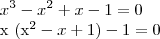
1ª equação:

2ª equação:



O resultado está errado. Eu que fiz errado ou esse é o jeito errado de resolver?
-
PedroCunha
- Usuário Ativo
-
- Mensagens: 21
- Registrado em: Dom Set 23, 2012 11:29
- Formação Escolar: ENSINO MÉDIO
- Andamento: cursando
por DanielFerreira » Dom Nov 18, 2012 10:22
PedroCunha escreveu:Para encontrar as raízes dessa equação teria que colocar em evidência também, certo?
Acredito que essa seja a forma mais simples.
Dê uma olhada nesse tópico
http://www.ajudamatematica.com/viewtopic.php?f=116&t=10230&p=35729#p35729.
Mas, existe outra forma...
"Sabedoria é saber o que fazer;
habilidade é saber como fazer;
virtude é fazer."
(David S. Jordan)
--------------------------------------------------------------------------------
-
DanielFerreira
- Colaborador - em formação
-
- Mensagens: 1732
- Registrado em: Qui Jul 23, 2009 21:34
- Localização: Mangaratiba - RJ
- Formação Escolar: GRADUAÇÃO
- Área/Curso: Licenciatura em Matemática - IFRJ
- Andamento: formado
-
por PedroCunha » Dom Nov 18, 2012 10:53
Ahh..entendi o jeito de certo de fatorar. Aqui vai conta, veja se está certa por favor.

1ª Resposta:

2ª Resposta:


Att.,
Pedro
-
PedroCunha
- Usuário Ativo
-
- Mensagens: 21
- Registrado em: Dom Set 23, 2012 11:29
- Formação Escolar: ENSINO MÉDIO
- Andamento: cursando
por DanielFerreira » Ter Nov 20, 2012 21:07
Sim, está certo!

"Sabedoria é saber o que fazer;
habilidade é saber como fazer;
virtude é fazer."
(David S. Jordan)
--------------------------------------------------------------------------------
-
DanielFerreira
- Colaborador - em formação
-
- Mensagens: 1732
- Registrado em: Qui Jul 23, 2009 21:34
- Localização: Mangaratiba - RJ
- Formação Escolar: GRADUAÇÃO
- Área/Curso: Licenciatura em Matemática - IFRJ
- Andamento: formado
-
por PedroCunha » Ter Nov 20, 2012 21:31
Obrigado por toda a ajuda Dan,

.
-
PedroCunha
- Usuário Ativo
-
- Mensagens: 21
- Registrado em: Dom Set 23, 2012 11:29
- Formação Escolar: ENSINO MÉDIO
- Andamento: cursando
Voltar para Polinômios
Se chegou até aqui, provavelmente tenha interesse pelos tópicos relacionados abaixo.
Aproveite a leitura. Bons estudos!
-
- Dúvidas sobre polinômios
por Lorraine » Sex Mai 13, 2011 10:17
- 1 Respostas
- 2085 Exibições
- Última mensagem por FilipeCaceres

Sex Mai 13, 2011 11:22
Polinômios
-
- [polinômios] questão uel
por Flavia R » Ter Ago 30, 2011 12:45
- 0 Respostas
- 1828 Exibições
- Última mensagem por Flavia R
Ter Ago 30, 2011 12:45
Polinômios
-
- Polinômios - Questão
por iceman » Dom Mai 27, 2012 18:23
- 1 Respostas
- 1579 Exibições
- Última mensagem por DanielFerreira
Dom Mai 27, 2012 18:26
Polinômios
-
- Polinômios - Questão
por iceman » Dom Mai 27, 2012 23:51
- 1 Respostas
- 1507 Exibições
- Última mensagem por Cleyson007
Ter Mai 29, 2012 17:39
Polinômios
-
- Questão de Intervalo em Polinômios
por joedsonazevedo » Qui Nov 15, 2012 11:34
- 1 Respostas
- 1790 Exibições
- Última mensagem por DanielFerreira
Qui Nov 15, 2012 13:31
Polinômios
Usuários navegando neste fórum: Nenhum usuário registrado e 7 visitantes
Assunto:
Funções
Autor:
Emilia - Sex Dez 03, 2010 13:24
Preciso de ajuda no seguinte problema:
O governo de um Estado Brasileiro mudou a contribuição previdenciária de seus contribuintes. era de 6% sobre qualquer salário; passou para 11% sobre o que excede R$1.200,00 nos salários. Por exemplo, sobre uma salário de R$1.700,00, a contribuição anterior era: 0,06x R$1.700,00 = R$102,00; e a atual é: 0,11x(R$1.700,00 - R$1.200,00) = R$55,00.
i. Determine as funções que fornecem o valor das contribuições em função do valor x do salário antes e depois da mudança na forma de cobrança.
ii. Esboce seus gráficos.
iii. Determine os valores de salários para os quais:
- a contribuição diminuiu;
- a contribuição permaneceu a mesma;
- a contribuição aumentou.
Powered by phpBB © phpBB Group.
phpBB Mobile / SEO by Artodia.
![\\ (1 - x)(1 - x)x = 1 - x^2 \\\\ (1 - x)(1 - x)x = (1 + x)(1 - x) \\\\ (1 - x)(1 - x)x - (1 + x)(1 - x) = 0 \\\\ (1 - x)\left [ x(1 - x) - (1 + x) \right ] = 0 \\\\ (1 - x)(\cancel{x} - x^2 - 1 \cancel{- x}) = 0 \\\\ (1 - x)(- x^2 - 1) = 0 \\\\ (1 - x) \cdot - 1 \cdot (x^2 + 1) = 0 \\\\ - (1 - x)(x^2 + 1) = 0 \\\\ (x - 1)(x^2 + 1) = 0 \\\\ \begin{cases} x - 1 = 0 \\ x^2 + 1 = 0 \end{cases} \\\\\\ \blacklozenge \,\, x - 1 = 0 \\ \boxed{\boxed{x = 1}} \\\\\\ \blacklozenge \,\, x^2 + 1 = 0 \\ \Delta = 0 - 4 \\ \Delta = - 4 \\ \Delta = 4i^2 \\\\ x = \frac{0 \pm \sqrt{4i^2}}{2} \\\\ \boxed{\boxed{x' = i}} \,\, \textup{e} \,\, \boxed{\boxed{x' = - i}}](/latexrender/pictures/71765d5b44e0ba5d06b9cf3b56a72b74.png "\\ (1 - x)(1 - x)x = 1 - x^2 \\\\ (1 - x)(1 - x)x = (1 + x)(1 - x) \\\\ (1 - x)(1 - x)x - (1 + x)(1 - x) = 0 \\\\ (1 - x)\left [ x(1 - x) - (1 + x) \right ] = 0 \\\\ (1 - x)(\cancel{x} - x^2 - 1 \cancel{- x}) = 0 \\\\ (1 - x)(- x^2 - 1) = 0 \\\\ (1 - x) \cdot - 1 \cdot (x^2 + 1) = 0 \\\\ - (1 - x)(x^2 + 1) = 0 \\\\ (x - 1)(x^2 + 1) = 0 \\\\ \begin{cases} x - 1 = 0 \\ x^2 + 1 = 0 \end{cases} \\\\\\ \blacklozenge \,\, x - 1 = 0 \\ \boxed{\boxed{x = 1}} \\\\\\ \blacklozenge \,\, x^2 + 1 = 0 \\ \Delta = 0 - 4 \\ \Delta = - 4 \\ \Delta = 4i^2 \\\\ x = \frac{0 \pm \sqrt{4i^2}}{2} \\\\ \boxed{\boxed{x' = i}} \,\, \textup{e} \,\, \boxed{\boxed{x' = - i}}")