por guilherme5088 » Sex Nov 01, 2019 18:42
determinar a constante a tal que a função f(x)=x^2+a/x tenha um mínimo local em x=2. Mostre que tal função não pode ter máximo local para nenhum valor de a.
-
guilherme5088
- Usuário Ativo

-
- Mensagens: 22
- Registrado em: Seg Set 02, 2019 22:46
- Formação Escolar: GRADUAÇÃO
- Área/Curso: engenharia eletrica
- Andamento: cursando
por guilherme5088 » Sex Nov 01, 2019 18:43
Eu consegui determinar o valor de a, derivando e igualando a 0 no ponto x=2, mas não entendi como justificar a segunda parte
-
guilherme5088
- Usuário Ativo
-
- Mensagens: 22
- Registrado em: Seg Set 02, 2019 22:46
- Formação Escolar: GRADUAÇÃO
- Área/Curso: engenharia eletrica
- Andamento: cursando
por adauto martins » Sex Nov 01, 2019 21:52
![y={x}^{2}+(a/x)...y'=({x}^{2})'+a.(1/x)'
y=2x+(-1).a/({x}^{2})\Rightarrow y'=0
(2.{x}^{3}-a)/({x}^{2})=0\Rightarrow x\neq 0...{x}^{3}=a/2
x=\sqrt[3]{a/2}](/latexrender/pictures/4c822729645a84e05051dc74c274a453.png "y={x}^{2}+(a/x)...y'=({x}^{2})'+a.(1/x)'
y=2x+(-1).a/({x}^{2})\Rightarrow y'=0
(2.{x}^{3}-a)/({x}^{2})=0\Rightarrow x\neq 0...{x}^{3}=a/2
x=\sqrt[3]{a/2}")
bom para saber se
![x=\sqrt[3]{a/2}](/latexrender/pictures/59de4b441ea97f7b6a8e7d0387e25e34.png "x=\sqrt[3]{a/2}")
é ponto de maximo ou minimo,devemos calcular a derivada segunda nesse ponto,entao:

bom para se ter um minimo em x=2,teriamos que ter:

agora vamos verificar a condiçao de a para que a funçao tenha um maximo,ou seja
![y''(\sqrt[3]{a/2})\prec 0...
y''(\sqrt[3]{a/2})=(2.{\sqrt[3]{a/2}}^{3}-2a)/({\sqrt[3]{a/2}}^{3})
(2.(a/2)-2a)/(a/2)\prec 0\Rightarrow
a-2a\prec (a/2)\Rightarrow -1\prec (1/2)](/latexrender/pictures/2bac1080c6f0eac26a38b740bf12bebd.png "y''(\sqrt[3]{a/2})\prec 0...
y''(\sqrt[3]{a/2})=(2.{\sqrt[3]{a/2}}^{3}-2a)/({\sqrt[3]{a/2}}^{3})
(2.(a/2)-2a)/(a/2)\prec 0\Rightarrow
a-2a\prec (a/2)\Rightarrow -1\prec (1/2)")
fato esse que impoe y ter um maximo,pois
![y''(\sqrt[3]{a/2})=(2.{\sqrt[3]{a/2}}^{3}-2a)/({\sqrt[3]{a/2}}^{3})
y''(\sqrt[3]{a/2})=(2(a/2)-2a)/(a/2)=2(a-2a)/a=-2\prec 0...](/latexrender/pictures/29fef2115f60e270b9e5d22da0f3d4a1.png "y''(\sqrt[3]{a/2})=(2.{\sqrt[3]{a/2}}^{3}-2a)/({\sqrt[3]{a/2}}^{3})
y''(\sqrt[3]{a/2})=(2(a/2)-2a)/(a/2)=2(a-2a)/a=-2\prec 0...")
logo y tera maximo no ponto
-
adauto martins
- Colaborador Voluntário

-
- Mensagens: 1171
- Registrado em: Sex Set 05, 2014 19:37
- Formação Escolar: EJA
- Área/Curso: matematica
- Andamento: cursando
por guilherme5088 » Sáb Nov 02, 2019 08:31
Acho que vc errou a segunda derivada, f"(x)= 2+2a/x^3.
Além disso, não entendi a parte final da resolução,pois a questão pede pra mostrar que a função NÃO pode ter máximo local para nenhum valor de a
-
guilherme5088
- Usuário Ativo
-
- Mensagens: 22
- Registrado em: Seg Set 02, 2019 22:46
- Formação Escolar: GRADUAÇÃO
- Área/Curso: engenharia eletrica
- Andamento: cursando
por adauto martins » Sáb Nov 02, 2019 11:58
eh,vc esta correto meu caro guilherme.eu erro muito,quando muitos calculos,contas,e usando o LATEX é que erro mesmo.obrigado...vamos entao as questoes:
primeiro o problema pede um valor para a,de tal sorte,que o ponto seja de minimo:
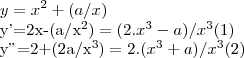

condiçao para se ter minimo em x=2...

agora vamos analisar a condiçao de a ser ponto de maximo:
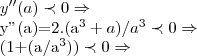

![\Rightarrow a\succ \sqrt[]{-1}](/latexrender/pictures/4b67b09322cf834cb2409d4835cce297.png "\Rightarrow a\succ \sqrt[]{-1}")
nessa condiçao a nao pode ser real,logo a nao pode ser ponto de maximo...
-
adauto martins
- Colaborador Voluntário
-
- Mensagens: 1171
- Registrado em: Sex Set 05, 2014 19:37
- Formação Escolar: EJA
- Área/Curso: matematica
- Andamento: cursando
por guilherme5088 » Sáb Nov 02, 2019 12:13
Eu resolvi de outro jeito, não sei se ta certo.
f'(x)=2x^3-a/x^2 igualei a 0 para determinar o ponto crítico, para determinar se esse ponto é de máximo f"(c)<0, sendo que f"(c)=6 que é maior que 0 ou seja por contradição f só tem ponto de mínimo local e isso ocorre quando x=2.
x^3= a/2, a=16.
Posso resolver desse jeito?
-
guilherme5088
- Usuário Ativo
-
- Mensagens: 22
- Registrado em: Seg Set 02, 2019 22:46
- Formação Escolar: GRADUAÇÃO
- Área/Curso: engenharia eletrica
- Andamento: cursando
por adauto martins » Sáb Nov 02, 2019 15:25
"determinar a constante a tal que a função f(x)=x^2+a/x tenha um mínimo local em x=2. Mostre que tal função não pode ter máximo local para nenhum valor de a."
meu caro guilherme,
a questao esta impondo uma condiçao,para se determinar um minimo em x=2...
em funçao desta condiçao,determinamos que a assume valores de

,que eu cheguei e vc no que acabaste de concluir...anterormente,cheguei que y tera maximo ou minimo em
...logo,para x=2,teriamos
![\sqrt[3]{a/2}=2\Rightarrow (a/2)=8...a=16...](/latexrender/pictures/4f5344b66be4819e6b2cdd2bb0c49bfa.png "\sqrt[3]{a/2}=2\Rightarrow (a/2)=8...a=16...")
foi o que vc fez,e esta correto...e que f''(2) é positivo,logo ter minimo...nessas condiçoes esta correto...
-
adauto martins
- Colaborador Voluntário
-
- Mensagens: 1171
- Registrado em: Sex Set 05, 2014 19:37
- Formação Escolar: EJA
- Área/Curso: matematica
- Andamento: cursando
por adauto martins » Sáb Nov 02, 2019 15:36
envei antes,
vamos voltar a questao...
agora vamos testar porque y,nao tem maximo...como vc fez a correçao da minha derivada segunda...
![y''(\sqrt[3]{(a/2)})=2+(2a/{\sqrt[3]{(a/2)}}^{3})=2+(2a/(a/2))
y''(\sqrt[3]{(a/2)})=2+4=6\succ 0...](/latexrender/pictures/1523a8b3e751d2cdb5af7b2b985311ce.png "y''(\sqrt[3]{(a/2)})=2+(2a/{\sqrt[3]{(a/2)}}^{3})=2+(2a/(a/2))
y''(\sqrt[3]{(a/2)})=2+4=6\succ 0...")
o que mostra que y,so tera minimo,que de sua maneira esta correto...
-
adauto martins
- Colaborador Voluntário
-
- Mensagens: 1171
- Registrado em: Sex Set 05, 2014 19:37
- Formação Escolar: EJA
- Área/Curso: matematica
- Andamento: cursando
Voltar para Cálculo: Limites, Derivadas e Integrais
Se chegou até aqui, provavelmente tenha interesse pelos tópicos relacionados abaixo.
Aproveite a leitura. Bons estudos!
-
- [Derivada] Ajuda com calculo de derivada de função quociente
por alienpuke » Dom Out 25, 2015 15:31
- 1 Respostas
- 13166 Exibições
- Última mensagem por Cleyson007

Dom Out 25, 2015 16:47
Cálculo: Limites, Derivadas e Integrais
-
- [derivada] derivada pela definição da secante
por TheKyabu » Sáb Out 27, 2012 23:24
- 2 Respostas
- 10924 Exibições
- Última mensagem por TheKyabu
Dom Out 28, 2012 11:44
Cálculo: Limites, Derivadas e Integrais
-
- [Derivada] Com duas variáveis e derivada mista
por leticiaeverson » Dom Abr 22, 2018 00:39
- 3 Respostas
- 13233 Exibições
- Última mensagem por Gebe
Dom Abr 22, 2018 17:11
Cálculo: Limites, Derivadas e Integrais
-
- [Derivada]derivada de função de raiz cúbica
por armando » Sáb Jul 20, 2013 15:22
- 4 Respostas
- 14859 Exibições
- Última mensagem por armando
Dom Jul 21, 2013 22:17
Cálculo: Limites, Derivadas e Integrais
-
- [DERIVADA] DERIVADA POR DEFINIÇÃO DA RAIZ DO MÓDULO DE X
por Matheusgdp » Qua Set 16, 2015 04:07
- 2 Respostas
- 5145 Exibições
- Última mensagem por Matheusgdp
Qui Set 17, 2015 18:31
Cálculo: Limites, Derivadas e Integrais
Usuários navegando neste fórum: Nenhum usuário registrado e 59 visitantes
Assunto:
dúvida em uma questão em regra de 3!
Autor:
leandro moraes - Qui Jul 01, 2010 12:41
pessoal eu achei como resultado 180 toneladas,entretanto sei que a questão está erra pela lógica e a resposta correta segundo o gabarito é 1.800 toneladas.
me explique onde eu estou pecando na questão. resolva explicando.
78 – ( CEFET – 1993 ) Os desabamentos, em sua maioria, são causados por grande acúmulo de lixo nas encostas dos morros. Se 10 pessoas retiram 135 toneladas de lixo em 9 dias, quantas toneladas serão retiradas por 40 pessoas em 30 dias ?
Assunto:
dúvida em uma questão em regra de 3!
Autor:
Douglasm - Qui Jul 01, 2010 13:16
Observe o raciocínio:
10 pessoas - 9 dias - 135 toneladas
1 pessoa - 9 dias - 13,5 toneladas
1 pessoa - 1 dia - 1,5 toneladas
40 pessoas - 1 dia - 60 toneladas
40 pessoas - 30 dias - 1800 toneladas
Assunto:
dúvida em uma questão em regra de 3!
Autor:
leandro moraes - Qui Jul 01, 2010 13:18
pessoal já achei a resposta. o meu erro foi bobo rsrsrrs errei em uma continha de multiplicação, é mole rsrsrsr mas felizmente consegui.
Assunto:
dúvida em uma questão em regra de 3!
Autor:
leandro moraes - Qui Jul 01, 2010 13:21
leandro moraes escreveu:pessoal já achei a resposta. o meu erro foi bobo rsrsrrs errei em uma continha de multiplicação, é mole rsrsrsr mas felizmente consegui.
valeu meu camarada.
Powered by phpBB © phpBB Group.
phpBB Mobile / SEO by Artodia.