por baianinha » Seg Fev 21, 2011 12:59
-
baianinha
- Usuário Ativo

-
- Mensagens: 23
- Registrado em: Qui Dez 16, 2010 12:15
- Formação Escolar: ENSINO MÉDIO PROFISSIONALIZANTE
- Área/Curso: matematica
- Andamento: cursando
por LuizAquino » Ter Fev 22, 2011 16:44
baianinha escreveu:Sabe-se que a matriz de uma transformação linear

é dada por
![[T]_A^B = \begin{bmatrix} 1 & 1 & 0 \\ 0 & 1 & 0 \\ 0 & 0 & -1 \\ 0 & 0 & 1 \end{bmatrix}](/latexrender/pictures/47c2b8e373a3cbbcb8866e0340699d7f.png "[T]_A^B = \begin{bmatrix} 1 & 1 & 0 \\ 0 & 1 & 0 \\ 0 & 0 & -1 \\ 0 & 0 & 1 \end{bmatrix}")
,
considerando as bases

de

e

de

.
Encontrar a expressão de T(p).
Do conhecimento de Álgebra Linear, sabemos que:
![[T(p)]_B = [T]_A^B[p]_A](/latexrender/pictures/3a93f5d0d1f92a231aa44c06f4ed5684.png "[T(p)]_B = [T]_A^B[p]_A")
onde
![[T(p)]_B](/latexrender/pictures/0623fe724e2938dcf2045ddec7cd0665.png "[T(p)]_B")
- vetor de coordenadas de T(p) na base B;
![[T]_A^B](/latexrender/pictures/f6e319aa809880a0d493de6315e37e04.png "[T]_A^B")
- matriz de T em relação as bases A e B;
![[p]_A](/latexrender/pictures/f19f70d560dcff52eeac3ddc1baf38e0.png "[p]_A")
- vetor de coordenadas de p na base A;
Primeiro, vamos determinar quem é o vetor de coordenadas de p na base A. Sabemos que um polinômio de 2° grau é dado por

. Nós queremos descobrir os escalares k1, k2 e k3 de modo que

. Arrumando essa equação e comparando os coeficientes dos polinômios, é fácil obter que

,

,

. Portanto, temos que:
![[p]_A = \begin{bmatrix} b -\frac{c}{2} \\ \frac{c}{2} \\ a \end{bmatrix}_A](/latexrender/pictures/f45165aaa3dcd73405a55ee2c811ac2e.png "[p]_A = \begin{bmatrix} b -\frac{c}{2} \\ \frac{c}{2} \\ a \end{bmatrix}_A")
Desse modo, obtemos que:
![[T(p)]_B = [T]_A^B[p]_A = \begin{bmatrix} 1 & 1 & 0 \\ 0 & 1 & 0 \\ 0 & 0 & -1 \\ 0 & 0 & 1 \end{bmatrix}_A^B \begin{bmatrix} b -\frac{c}{2} \\ \frac{c}{2} \\ a \end{bmatrix}_A = \begin{bmatrix} b \\ \frac{c}{2} \\ - a \\ a \end{bmatrix}_B](/latexrender/pictures/9505de078f9f7005965576b081c636d1.png "[T(p)]_B = [T]_A^B[p]_A = \begin{bmatrix} 1 & 1 & 0 \\ 0 & 1 & 0 \\ 0 & 0 & -1 \\ 0 & 0 & 1 \end{bmatrix}_A^B \begin{bmatrix} b -\frac{c}{2} \\ \frac{c}{2} \\ a \end{bmatrix}_A = \begin{bmatrix} b \\ \frac{c}{2} \\ - a \\ a \end{bmatrix}_B")
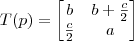
Escrevendo
usando o vetor de coordenadas calculado e a base B dada, nós temos:

-

LuizAquino
- Colaborador Moderador - Professor

-
- Mensagens: 2654
- Registrado em: Sex Jan 21, 2011 09:11
- Localização: Teófilo Otoni - MG
- Formação Escolar: PÓS-GRADUAÇÃO
- Área/Curso: Mestrado - Modelagem Computacional
- Andamento: formado
-
Voltar para Álgebra Linear
Se chegou até aqui, provavelmente tenha interesse pelos tópicos relacionados abaixo.
Aproveite a leitura. Bons estudos!
-
- [Algebra Linear] - Matriz de uma trasnformacao linear, Ajuda
por rodrigojuara » Dom Nov 30, 2014 15:05
- 1 Respostas
- 8216 Exibições
- Última mensagem por adauto martins

Seg Dez 01, 2014 16:12
Álgebra Linear
-
- [Algebra Linear] - Composição de transformação Linear
por aligames321 » Ter Dez 04, 2012 23:53
- 1 Respostas
- 10615 Exibições
- Última mensagem por young_jedi
Qua Dez 05, 2012 12:45
Álgebra Linear
-
- Álgebra Linear -Transformação linear- Isomorfismo
por anapaulasql » Ter Jan 27, 2015 22:08
- 1 Respostas
- 11652 Exibições
- Última mensagem por adauto martins
Ter Mar 29, 2016 13:15
Álgebra Linear
-
- [Álgebra Linear] Transformação Linear Idenpotente
por Zubumafu67 » Ter Nov 17, 2020 11:38
- 0 Respostas
- 14683 Exibições
- Última mensagem por Zubumafu67
Ter Nov 17, 2020 11:38
Álgebra Linear
-
- [Álgebra Linear] Transformação linear
por Debby » Dom Mai 27, 2012 12:17
- 2 Respostas
- 9216 Exibições
- Última mensagem por Debby
Dom Mai 27, 2012 20:27
Álgebra Linear
Usuários navegando neste fórum: Nenhum usuário registrado e 10 visitantes
Assunto:
método de contagem
Autor:
sinuca147 - Seg Mai 25, 2009 09:10
Veja este exercício:
Se A = {

} e B = {

}, então o número de elementos A

B é:
Eu tentei resolver este exercício e achei a resposta "três", mas surgiram muitas dúvidas aqui durante a resolução.
Para determinar os elementos do conjunto A, eu tive de basicamente fazer um lista de vinte dividido por todos os números naturais maiores que zero e menores que vinte e um, finalmente identificando como elementos do conjunto A os números 1, 2, 4, 5, 10 e 20. Acho que procedi de maneira correta, mas fiquei pensando aqui se não existiria um método mais "sofisticado" e prático para que eu pudesse identificar ou ao menos contar o número de elementos do conjunto A, existe?
No processo de determinação dos elementos do conjunto B o que achei foi basicamente os múltiplos de cinco e seus opostos, daí me surgiram estas dúvidas:
existe oposto de zero?
existe inverso de zero?
zero é par, certo?
sendo x um número natural, -x é múltiplo de x?
sendo z um número inteiro negativo, z é múltiplo de z?
sendo z um número inteiro negativo, -z é múltiplo de z?
A resposta é 3?
Obrigado.
Assunto:
método de contagem
Autor:
Molina - Seg Mai 25, 2009 20:42
Boa noite, sinuca.
Se A = {
} você concorda que n só pode ser de 1 a 20? Já que pertence aos naturais?
Ou seja, quais são os divisores de 20? Eles são seis: 1, 2, 4, 5, 10 e 20.
Logo, o conjunto A é
A = {1, 2, 4, 5, 10, 20}
Se B = {
} você concorda que x será os múltiplos de 5 (positivos e negativos)? Já que m pertence ao conjunto Z?
Logo, o conjunto B é
B = {... , -25, -20, -15, -10, -5, 0, 5, 10, 15, 20, 25, ...
Feito isso precisamos ver os números que está em ambos os conjuntos, que são:
5, 10 e 20 (3 valores, como você achou).
Vou responder rapidamente suas dúvidas porque meu tempo está estourando. Qualquer dúvida, coloque aqui, ok?
sinuca147 escreveu:No processo de determinação dos elementos do conjunto B o que achei foi basicamente os múltiplos de cinco e seus opostos, daí me surgiram estas dúvidas:
existe oposto de zero? sim, é o próprio zero
existe inverso de zero? não, pois não há nenhum número que multiplicado por zero resulte em 1
zero é par, certo? sim, pois pode ser escrito da forma de 2n, onde n pertence aos inteiros
sendo x um número natural, -x é múltiplo de x? Sim, pois basta pegar x e multiplicar por -1 que encontramos -x
sendo z um número inteiro negativo, z é múltiplo de z? Sim, tais perguntando se todo número é multiplo de si mesmo
sendo z um número inteiro negativo, -z é múltiplo de z? Sim, pois basta pegar -z e multiplicar por -1 que encontramos x
A resposta é 3? Sim, pelo menos foi o que vimos a cima
Bom estudo,

Assunto:
método de contagem
Autor:
sinuca147 - Seg Mai 25, 2009 23:35
Obrigado, mas olha só este link
http://www.colegioweb.com.br/matematica ... ro-natural
neste link encontra-se a a frase:
Múltiplo de um número natural é qualquer número que possa ser obtido multiplicando o número natural por 0, 1, 2, 3, 4, 5, etc.
Para determinarmos os múltiplos de 15, por exemplo, devemos multiplicá-lo pela sucessão dos números naturais:
Ou seja, de acordo com este link -5 não poderia ser múltiplo de 5, assim como 5 não poderia ser múltiplo de -5, eu sempre achei que não interessava o sinal na questão dos múltiplos, assim como você me confirmou, mas e essa informação contrária deste site, tem alguma credibilidade?
Há e claro, a coisa mais bacana você esqueceu, quero saber se existe algum método de contagem diferente do manual neste caso:
Para determinar os elementos do conjunto A, eu tive de basicamente fazer um lista de vinte dividido por todos os números naturais maiores que zero e menores que vinte e um, finalmente identificando como elementos do conjunto A os números 1, 2, 4, 5, 10 e 20. Acho que procedi de maneira correta, mas fiquei pensando aqui se não existiria um método mais "sofisticado" e prático para que eu pudesse identificar ou ao menos contar o número de elementos do conjunto A, existe?
Powered by phpBB © phpBB Group.
phpBB Mobile / SEO by Artodia.
 (R)
(R)
 } do
} do 
![{\left[
\begin{vmatrix}
1 & 1 \\
0 & 0
\end{vmatrix}
\right],](/latexrender/pictures/30224cef379713444b07169de3eb7b7d.png "{\left[
\begin{vmatrix}
1 & 1 \\
0 & 0
\end{vmatrix}
\right],")
![\left[
\begin{vmatrix}
0 & 1 \\
1 & 0
\end{vmatrix}
\right],](/latexrender/pictures/892179d9a47cb9a55b6029426629014c.png "\left[
\begin{vmatrix}
0 & 1 \\
1 & 0
\end{vmatrix}
\right],")
![\left[
\begin{vmatrix}
0 & 0 \\
1 & 1
\end{vmatrix},}
\right],](/latexrender/pictures/6bca50fb8ca4c49f3f8141ac14ce9e85.png "\left[
\begin{vmatrix}
0 & 0 \\
1 & 1
\end{vmatrix},}
\right],")
![\left[
\begin{vmatrix}
0 & 0 \\
1 & 2
\end{vmatrix}
\right],](/latexrender/pictures/4c4c1bb8edd9cefd669f6d47f9527794.png "\left[
\begin{vmatrix}
0 & 0 \\
1 & 2
\end{vmatrix}
\right],")
![\left[T \right]A.B=
\begin{pmatrix}
1 & 1 & 0 \\
0 & 1 & 0 \\
0 & 0 & -1 \\
0 & 0 & 1
\end{pmatrix}](/latexrender/pictures/4caa26fdd7e878bc859bc617ed953119.png "\left[T \right]A.B=
\begin{pmatrix}
1 & 1 & 0 \\
0 & 1 & 0 \\
0 & 0 & -1 \\
0 & 0 & 1
\end{pmatrix}")