por stuart clark » Ter Jul 08, 2014 04:04
Evaluation of
![\displaystyle \int \sqrt[4]{\tan x}dx](/latexrender/pictures/dc8f98b38a94c51f80a1c94db7fc222b.png "\displaystyle \int \sqrt[4]{\tan x}dx")
-
stuart clark
- Usuário Dedicado

-
- Mensagens: 34
- Registrado em: Sáb Mai 28, 2011 00:32
- Formação Escolar: GRADUAÇÃO
- Andamento: cursando
por e8group » Ter Jul 08, 2014 14:10
Every positive number can be written as a positive number to the power 4 . In order to us evaluate the integral ,let

. Taking a derivative from both sides of

, we get

. Now , we use an identity to give an expression a more convenient form

.Thus
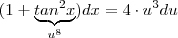
which yields
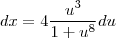
. And finally we have ,
![\int \sqrt[4]{tan(x)} dx = 4 \int \frac{u^4}{1+u^8} du](/latexrender/pictures/d4e5f45ad7247613c937846a5ae19cbf.png "\int \sqrt[4]{tan(x)} dx = 4 \int \frac{u^4}{1+u^8} du")
.
I'm not sure if i'm on the right track ... Perhaps , we can attempt to use partial
fraction decomposition to write the latter integrand as a sum of fractions .
There's a trick to express

as a
product of two irreducible polynomials ...

-
e8group
- Colaborador Voluntário

-
- Mensagens: 1400
- Registrado em: Sex Jun 01, 2012 12:10
- Formação Escolar: GRADUAÇÃO
- Área/Curso: Engenharia Elétrica
- Andamento: cursando
Voltar para Cálculo: Limites, Derivadas e Integrais
Se chegou até aqui, provavelmente tenha interesse pelos tópicos relacionados abaixo.
Aproveite a leitura. Bons estudos!
-
- Pre-Universitario Trig....
por Pre-Universitario » Sex Ago 12, 2011 19:33
- 0 Respostas
- 1174 Exibições
- Última mensagem por Pre-Universitario

Sex Ago 12, 2011 19:33
Trigonometria
-
- trig integration
por stuart clark » Sáb Jan 14, 2017 06:45
- 1 Respostas
- 2002 Exibições
- Última mensagem por e8group
Sex Fev 03, 2017 12:36
Cálculo: Limites, Derivadas e Integrais
-
- Expressão - Razões Trig.
por Apotema » Ter Nov 24, 2009 08:02
- 1 Respostas
- 3277 Exibições
- Última mensagem por thadeu
Ter Nov 24, 2009 11:39
Trigonometria
-
- Numeros complexoe e trig.
 por lherme2008 » Dom Jul 22, 2012 21:29
- 2 Respostas
- 2877 Exibições
- Última mensagem por e8group
Seg Jul 23, 2012 17:37
Números Complexos
-
- [Integral] Estou com dificuldade para resolver esta integral
por Paulo Perez » Qui Out 03, 2013 12:22
- 2 Respostas
- 4649 Exibições
- Última mensagem por Paulo Perez
Sex Out 04, 2013 16:32
Cálculo: Limites, Derivadas e Integrais
Usuários navegando neste fórum: Nenhum usuário registrado e 51 visitantes
Assunto:
(FGV) ... função novamente rs
Autor:
my2009 - Qua Dez 08, 2010 21:48
Uma função polinomial f do 1° grau é tal que f(3) = 6 e f(4) = 8.Portanto o valor de f(10) é :
Assunto:
(FGV) ... função novamente rs
Autor: Anonymous - Qui Dez 09, 2010 17:25
Uma função de 1º grau é dada por

.
Temos que para

,

e para

,

.

Ache o valor de

e

, monte a função e substitua

por

.
Assunto:
(FGV) ... função novamente rs
Autor:
Pinho - Qui Dez 16, 2010 13:57
my2009 escreveu:Uma função polinomial f do 1° grau é tal que f(3) = 6 e f(4) = 8.Portanto o valor de f(10) é :
f(x)= 2.x
f(3)=2.3=6
f(4)=2.4=8
f(10)=2.10=20
Assunto:
(FGV) ... função novamente rs
Autor:
dagoth - Sex Dez 17, 2010 11:55
isso ai foi uma questao da FGV?
haahua to precisando trocar de faculdade.
Assunto:
(FGV) ... função novamente rs
Autor:
Thiago 86 - Qua Mar 06, 2013 23:11
Saudações!

ví suaquestão e tentei resolver, depois você conta-me se eu acertei.
Uma função de 1º grau é dada por y=3a+b
Resposta :
3a+b=6 x(4)
4a+b=8 x(-3)
12a+4b=24
-12a-3b=-24
b=0
substituindo b na 1°, ttenho que: 3a+b=6
3a+0=6
a=2
substituindo em: y=3a+b
y=30+0
y=30

Powered by phpBB © phpBB Group.
phpBB Mobile / SEO by Artodia.