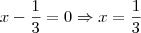
No que eu poderia ter errado?
Segue o que eu fiz:
![\lim_{x->1} \frac{\sqrt[]{x} - x^2}{1 - \sqrt[]{x}}](/latexrender/pictures/a3e9ccea57245b37958387b1239bc869.png "\lim_{x->1} \frac{\sqrt[]{x} - x^2}{1 - \sqrt[]{x}}")
1- Multipliquei pelo conjugado do denominador:
![\lim_{x->1} \frac{\sqrt[]{x} - x^2}{1 - \sqrt[]{x}}. \frac{1+\sqrt[]{x}}{1+\sqrt[]{x}}](/latexrender/pictures/23c9b6ecb27df6193b73afe42064ea31.png "\lim_{x->1} \frac{\sqrt[]{x} - x^2}{1 - \sqrt[]{x}}. \frac{1+\sqrt[]{x}}{1+\sqrt[]{x}}")
![\lim_{x->1} \frac{\sqrt[]{x}+x-x^2-{x}^{3/2}}{1-x}](/latexrender/pictures/ade7fc5a82fc4da677edef338b4dd9a9.png "\lim_{x->1} \frac{\sqrt[]{x}+x-x^2-{x}^{3/2}}{1-x}")
![\lim_{x->1} \frac{\sqrt[]{x}-{x}^{3/2}+x(1-x)}{1-x}](/latexrender/pictures/dd911ec045320aab86cafbadc78735a9.png "\lim_{x->1} \frac{\sqrt[]{x}-{x}^{3/2}+x(1-x)}{1-x}")
Assumindo 1-x diferente de 0:
![\lim_{x->1} \sqrt[]{x}-{x}^{3/2}+x](/latexrender/pictures/dc3f5584f3557db192d7245019eeab49.png "\lim_{x->1} \sqrt[]{x}-{x}^{3/2}+x")
![\lim_{x->1} \sqrt[]{x}-{x}^{3/2}+x=1](/latexrender/pictures/880694c02d17952944150212a511085f.png "\lim_{x->1} \sqrt[]{x}-{x}^{3/2}+x=1")
No Wolfram isso deu 3. Como pode?


 por RenanDias » Sáb Nov 02, 2013 19:47

por e8group » Sáb Nov 02, 2013 20:59
 é raiz de
  e de
e de  , logo como
  são contínuas p/ todo ponto de seu domínio, é natural que
  tendem a zero quando
  se aproxima de o quanto queremos .
 pode ser escrito como
  . Devido a este resultado teremos que
  .
.  e fatore
  . Tente concluir .
por RenanDias » Dom Nov 03, 2013 13:21
![\sqrt[]{x^2}=x](/latexrender/pictures/d61c303c516357b92d78eca46e3bfe18.png "\sqrt[]{x^2}=x") apenas para
apenas para  certo?
![\sqrt[]{x}=u](/latexrender/pictures/d85921e0080ddeccfae2e09875632b9f.png "\sqrt[]{x}=u") em
em
![\lim_{x->1} 1 + \lim_{x->1} \sqrt[]{x} + \lim_{x->1} x](/latexrender/pictures/3cb4702c2e1e7919a189b468b223cbdc.png "\lim_{x->1} 1 + \lim_{x->1} \sqrt[]{x} + \lim_{x->1} x")
por e8group » Dom Nov 03, 2013 13:54
 se
se  ,se tivéssemos
  , teríamos
  é a definição do módulo ,tendo em vista que
  . Porém sabemos que ,
  , pois
  é igual a uma das possibilidades ou
  e
e  . Então ,
  , foi este resultado que usei ,com ,temos
  .
.por RenanDias » Seg Nov 04, 2013 10:28
Voltar para Cálculo: Limites, Derivadas e Integrais
Usuários navegando neste fórum: Nenhum usuário registrado e 70 visitantes

 .
.
 :
: